

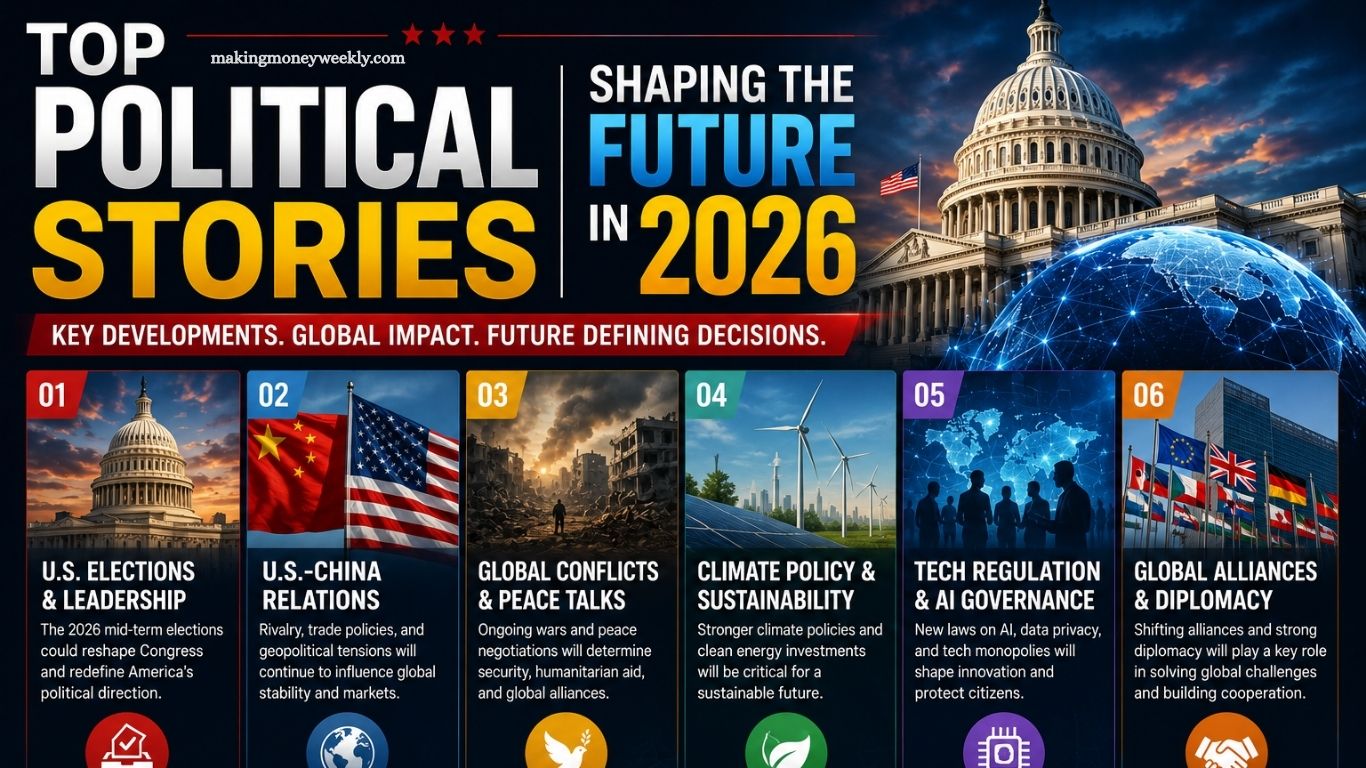
2026 is becoming a defining year for global politics. Governments are facing a combination of geopolitical conflicts, economic pressure, technological disruption, climate risks, and growing public distrust. These forces are changing how countries cooperate, compete, trade, and respond to international crises.
Political developments in 2026 are also reaching far beyond government institutions. Decisions involving tariffs, artificial intelligence, energy security, migration, national defense, and climate policy are influencing businesses, workers, consumers, and communities worldwide.
The World Economic Forum identifies geoeconomic confrontation, interstate conflict, extreme weather, polarization, and misinformation among the major risks shaping the current global environment.
Read More: Breaking Political News and Major Developments You Need to Know
A More Fragmented Global Power Structure
One of the biggest political stories shaping 2026 is the movement toward a more multipolar world. Global influence is no longer concentrated around a small number of traditional alliances. China, India, regional powers, emerging economies, and middle powers are increasingly seeking greater strategic independence.
This shift is changing diplomatic relationships and international institutions. Countries are becoming more selective about partnerships, balancing economic interests with national security concerns. The result is a world where cooperation can happen in one area while competition intensifies in another.
The World Economic Forum describes this transition as a new competitive order in which major powers increasingly seek to secure their own spheres of influence.
U.S.-China Competition Remains Central
Competition between the United States and China remains one of the most important political issues of 2026. The rivalry extends beyond traditional military power into semiconductors, artificial intelligence, advanced manufacturing, energy technology, trade, and global influence.
Technology has become a major part of national strategy. Governments increasingly view access to advanced chips, computing infrastructure, and AI capabilities as matters of economic and national security.
This competition could influence global supply chains for years. Companies are already facing pressure to diversify manufacturing and reduce exposure to geopolitical disruptions.
Trade Wars and Economic Nationalism
Trade policy is another major political story shaping the future. Governments are increasingly using tariffs, investment restrictions, export controls, and industrial policies to protect domestic industries and strengthen strategic sectors.
UN Trade and Development expects global trade growth to slow in 2026 as geopolitical fragmentation, protectionism, supply-chain changes, digital transformation, and tighter regulations reshape international commerce.
This trend could produce significant consequences for consumers and businesses. Higher trade barriers can increase production costs, while companies may move factories or suppliers closer to major markets.
The political debate is therefore shifting from simple free-trade arguments toward questions about economic security, supply-chain resilience, domestic employment, and technological independence.
Conflicts Continue to Reshape Foreign Policy
International conflicts remain another major force influencing politics in 2026. The Middle East has become particularly important for global diplomacy, energy markets, shipping, and security.
The continuing U.S.-Iran conflict has affected energy prices, regional relationships, and American domestic politics, while disruptions around the Strait of Hormuz have created wider economic concerns.
These developments demonstrate how a regional conflict can quickly become a global political and economic issue. Energy security, military alliances, sanctions, humanitarian concerns, and diplomatic negotiations are increasingly interconnected.
Artificial Intelligence Becomes a Political Issue
Artificial intelligence is moving rapidly from a technology discussion into a major political debate. Governments are considering how to regulate powerful AI systems while encouraging innovation and maintaining competitiveness.
AI policy now involves national security, employment, privacy, misinformation, cybersecurity, education, and economic inequality. The Atlantic Council identified AI governance, technology competition, and malicious AI applications as important geopolitical issues for 2026.
Political leaders face a difficult balance. Excessive regulation could slow innovation, while weak oversight could increase social and security risks.
The growing public debate around AI also shows that technology policy will increasingly influence elections and political movements. Concerns about job displacement, data centers, energy consumption, and corporate power are already producing stronger demands for government oversight.
Democracy and Public Trust Under Pressure
Another major political story is the continuing struggle over public trust. Political polarization, misinformation, economic inequality, and dissatisfaction with institutions are affecting democratic systems across different regions.
The World Economic Forum ranks misinformation and disinformation among the leading short-term global risks, while societal polarization remains a significant concern.
Voters are increasingly evaluating governments based on practical outcomes such as living costs, employment, housing, public safety, and access to services. When institutions fail to address these concerns, political frustration can grow quickly.
The future of democracy may therefore depend not only on elections but also on whether governments can restore confidence through effective and transparent governance.
Climate Change Is Becoming a Political Challenge
Climate change is no longer only an environmental issue. It is increasingly influencing foreign policy, migration, energy security, infrastructure, food supplies, and national budgets.
Extreme weather events are creating economic and political pressure in many countries. At the same time, governments must decide how quickly to transition toward cleaner energy without creating unaffordable costs for households and businesses.
Climate change is also affecting geopolitics. Melting Arctic ice, changing shipping routes, water shortages, and competition over clean-energy technologies are creating new strategic considerations.
Political leaders will increasingly need to connect climate policy with economic security and long-term national resilience.
Elections Could Reshape Political Direction
Elections remain one of the strongest forces capable of changing national policy. Political campaigns in 2026 are taking place against a background of economic uncertainty, geopolitical tensions, immigration debates, and growing polarization.
In countries heading toward important elections, voters are likely to focus heavily on household finances, national security, employment, energy prices, and government performance.
The political impact can extend beyond national borders. Leadership changes can alter trade agreements, military partnerships, climate commitments, immigration policies, and diplomatic relationships.
Migration and Border Policy Gain Importance
Migration continues to influence political debates around the world. Governments are under pressure to balance humanitarian responsibilities with border security, employment concerns, housing availability, and public services.
Political parties across different ideological positions are using migration policy as a major campaign issue. The debate is increasingly connected with demographic change, labor shortages, national identity, and economic inequality.
Future immigration policies could therefore have consequences far beyond border management, affecting labor markets and relationships between neighboring countries.
Energy Security Remains a Strategic Priority
Energy has returned to the center of global politics. Conflicts, shipping disruptions, sanctions, and changing energy markets have demonstrated how dependent economies remain on secure energy supplies.
At the same time, countries are competing to lead in solar power, batteries, electric vehicles, nuclear energy, and other emerging technologies.
The political challenge is finding a balance between affordable energy today and long-term energy independence. Countries that successfully combine energy security with technological innovation could gain significant economic and geopolitical advantages.
What These Political Trends Mean for the Future
The major political stories of 2026 are closely connected. Geopolitical competition affects trade. Trade policies influence inflation. Conflicts affect energy prices. AI changes labor markets. Climate change creates migration and security pressures. Political dissatisfaction can then influence elections and government policy.
This interconnected environment means governments cannot treat individual problems separately. The World Economic Forum warns that the most consequential risks increasingly emerge from interactions between geopolitical, technological, economic, environmental, and social forces.
The future will likely depend on how effectively governments manage these overlapping challenges. Countries that build resilient institutions, diversify economies, invest in technology responsibly, and maintain diplomatic relationships could be better positioned for uncertainty.
Frequently Asked Questions
What are the biggest political stories shaping 2026?
Major stories include geopolitical competition, trade tensions, global conflicts, AI regulation, elections, climate policy, and migration.
How is U.S.-China competition affecting global politics?
U.S.-China competition is influencing technology, trade, national security, supply chains, and international alliances.
Why is artificial intelligence becoming a political issue?
AI affects jobs, national security, privacy, misinformation, economic competition, and government regulation.
How are global conflicts affecting politics in 2026?
Conflicts are influencing diplomacy, energy prices, defense policies, international alliances, and global economic stability.
Why is climate change important to politics?
Climate change affects energy security, infrastructure, migration, food supplies, economic policy, and international cooperation.
How are elections shaping political trends in 2026?
Elections can change national policies involving trade, immigration, economic priorities, foreign relations, and security.
Conclusion
The top political stories shaping the future in 2026 reveal a world undergoing major transformation. Global power is becoming more fragmented, trade is becoming more strategic, conflicts are influencing economic decisions, and artificial intelligence is becoming a central policy issue.

1 Comment
Pingback: How New Government Policies Could Affect Millions of People - MakingMoneyWeekly